40. The Steel Phallus and Fertility Festival
Warning: The pictures for these festivals are too inappropriate for children, so I will not post any photos.
The Shinto Kanamara Matsuri (かなまら祭り, "Festival of the Steel Phallus") is held each spring at the Kanayama Shrine (金山神社 Kanayama-jinja) in Kawasaki, Japan. The exact dates may vary since the main festivities fall on the first Sunday in April. As the name of the festival suggests they are giving thanks and celebrating the penis. The penis, as the central theme of the event, is reflected in illustrations, candy, carved vegetables, decorations, and a mikoshi parade. The Kanamara Matsuri is centered on a local penis-venerating shrine once popular among prostitutes who wished to pray for protection from sexually transmitted diseases. It is said that if you pray there you are given business prosperity and clan prosperity; and given easy delivery at childbirth, marriage, and married-couple harmony.
There is a legend of a sharp-toothed demon (vagina dentata) that hid inside the vagina of a young woman and castrated two young men on their wedding nights. As a result, the young woman sought help from a blacksmith, who fashioned an iron phallus to break the demon's teeth, which led to the enshrinement of the item. From this legend there has been a few movie created like "Teeth" released in 2007 by Mitchell Lichtenstein.
Today, the festival has become something of a tourist attraction and is used to raise money for HIV research.
The Hōnen Matsuri (豊年祭, "Harvest Festival") is a fertility festival celebrated every year on March 15 in Japan. Hōnen means prosperous year in Japanese, implying a rich harvest, while a matsuri is a festival. The Hōnen festival and ceremony celebrate the blessings of a bountiful harvest and all manner of prosperity and fertility.
The best known of these festivals takes place in the town of Komaki, just north of Nagoya City. The festival's main features are Shinto priests playing musical instruments, a parade of ceremonially garbed participants, all-you-can-drink sake, and a 280 kg (620 pound), 2.5 meter (96 inch)-long wooden phallus.
This festival is to celebrate the good harvest and any form of fertility.
-The more you know~
Thursday, November 20, 2014

Interesting Facts! #39
39. The Red String of Fate~ <3

Like almost everything else in the Japanese culture this "Red String of Fate" has also originated in China and has been changed to the liking of the Japanese. The red string of fate, also referred to as the red string of marriage, and other names, is an East Asian belief originating from Chinese legend and is also used in Japanese legend. (Japanese:運命の赤い糸, unmei no akai ito, red string of fate)
According to myth, the gods tie an invisible red cord around the ankles of those that are destined to meet one another in a certain situation or help each other in a certain way. Often, in Japanese culture, it is thought to be tied around the pinky finger. The two people connected by the red thread are destined lovers, regardless of place, time, or circumstances. This magical cord may stretch or tangle, but never break. This myth is similar to the Western idea of a soulmate or a destined flame.
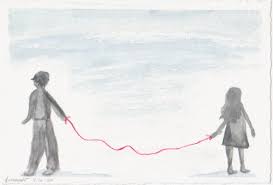 One story featuring the red string of fate involves a young boy. Walking home one night, a young boy sees an old man standing beneath the moonlight. The man explains to the boy that he is attached to his destined wife by a red thread. The old man shows the boy the young girl who is destined to be his wife. Being young and having no interest in having a wife, the young boy picks up a rock and throws it at the girl, running away. Many years later, when the boy has grown into a young man, his parents arrange a wedding for him. On the night of his wedding, his wife waits for him in their bedroom, with the traditional veil covering her face. Raising it, the man is delighted to find that his wife is one of the great beauties of his village. However, she wears an adornment (a jewel) on her eyebrow. He asks her why she wears it and she responds that when she was a young girl, a boy threw a rock at her that struck her, leaving a scar on her eyebrow. She self-consciously wears the adornment to cover it up. The woman is, in fact, the same young girl connected to the man by the red thread shown to him by the old man back in his childhood, showing that they were connected by the red string of fate.
 Manga, anime and many dramas are heavily influenced by this red string of fate. Where certain characters (mostly the main character) is tied to their destined lover. Even the Naruto Series has been influenced by the red string of fate, Kushina Uzumaki claims her red hair became her own red thread of fate that eventually linked her to Minato Namikaze. The Red String Of Fate is also mentioned in Sailor Moon, when Sailor Chibi Moon called on Pegasus with her Crystal Bell that had a red bow wrapped around it. Japanese culture is very influenced by the Red String of Fate that it pops up in movies, shows, music, games etc.
-The more you know~
According to myth, the gods tie an invisible red cord around the ankles of those that are destined to meet one another in a certain situation or help each other in a certain way. Often, in Japanese culture, it is thought to be tied around the pinky finger. The two people connected by the red thread are destined lovers, regardless of place, time, or circumstances. This magical cord may stretch or tangle, but never break. This myth is similar to the Western idea of a soulmate or a destined flame.
-The more you know~
Interesting Facts!! #38
38.Valentines Day and White Day

Valentine's day is celebrated on February 14. It is a type of festival of love and romance, many people give cards, letters, flowers or presents to their spouse or partner. But in Japan it is slightly different from everywhere else. Unlike the West, sending a Valentine's cards is not common in Japan, and the phrase "Happy Valentines" is not widely used.
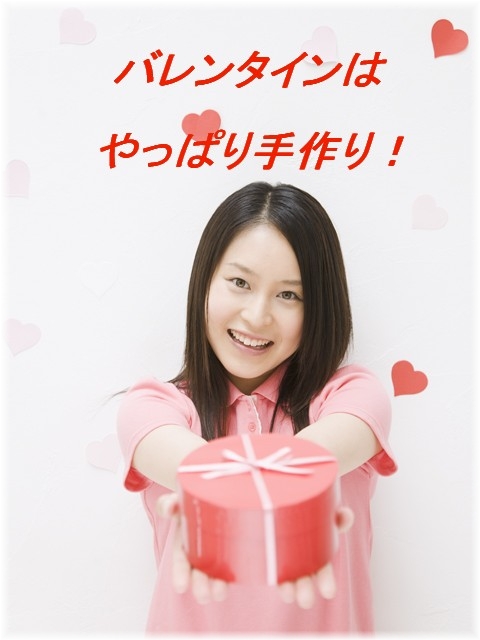
 In Japan Valentine’s Day is celebrated in a very unique style. It is the women who present gifts to men. There is a strong tradition of women giving chocolates to men on Valentines Day. Japanese women are usually too shy to express their love. (Though it might not be true nowadays.) Therefore, Valentine's Day was thought to be a great opportunity to let women express their feelings.
There are two types of chocolates, “Giri-choco” (obligation chocolate), and “Honmei-choco”. Giri-choco is meant to be for friends, colleagues, bosses, and close male friends. “Giri” means obligation hence this Giri-choco has no romance involved. On the other hand, Honmei-choco is given to a boyfriend, lover, or husband with true love. Japanese women often prepare the Honmei-choco by themselves as many of them think it is not true love if they just buy the ready made chocolate at shops.

There would be large displays of chocolate, often heart-shaped in department stores and grocery stores from mid-January. Days before the Valentine’s Day, stores get packed with a large variety of chocolates, the cooking tools, and women!

What is more unique in Japan is that there exists a “White Day” which takes place on March 14th, exactly one month after Valentine’s Day. On White Day men are supposed to give return gifts to women who gifted them chocolates on Valentine’s Day. More often the color of the chocolate is white because of the name of the day. Flowers, candies and other gifts are also popular along with the chocolates. Again, department stores have many advanced reminders with gift displays so men will have no excuse to forget about this special day which is important for women.
-The more you know~
 In Japan Valentine’s Day is celebrated in a very unique style. It is the women who present gifts to men. There is a strong tradition of women giving chocolates to men on Valentines Day. Japanese women are usually too shy to express their love. (Though it might not be true nowadays.) Therefore, Valentine's Day was thought to be a great opportunity to let women express their feelings.
 There are two types of chocolates, “Giri-choco” (obligation chocolate), and “Honmei-choco”. Giri-choco is meant to be for friends, colleagues, bosses, and close male friends. “Giri” means obligation hence this Giri-choco has no romance involved. On the other hand, Honmei-choco is given to a boyfriend, lover, or husband with true love. Japanese women often prepare the Honmei-choco by themselves as many of them think it is not true love if they just buy the ready made chocolate at shops.
There would be large displays of chocolate, often heart-shaped in department stores and grocery stores from mid-January. Days before the Valentine’s Day, stores get packed with a large variety of chocolates, the cooking tools, and women!
What is more unique in Japan is that there exists a “White Day” which takes place on March 14th, exactly one month after Valentine’s Day. On White Day men are supposed to give return gifts to women who gifted them chocolates on Valentine’s Day. More often the color of the chocolate is white because of the name of the day. Flowers, candies and other gifts are also popular along with the chocolates. Again, department stores have many advanced reminders with gift displays so men will have no excuse to forget about this special day which is important for women.
-The more you know~
Wednesday, November 19, 2014
Interesting Facts!! #37
37. Tattoos

Despite the popularity of Japanese art and imagery among tattoo artists and enthusiasts in the West, even the most beautiful piece of body work done by the most talented artist will result in disapproving looks and negative comments. Even the smallest, most insignificant tattoo will get you thrown out or prohibited from entering certain public places.
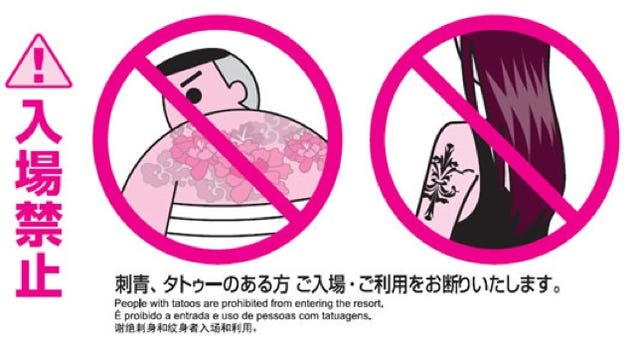
There are prominent, clearly labeled signs at establishments like fitness gyms, public swimming pools, and especially at Japan’s renown hot springs, that state anyone with irezumi, the Japanese word for ‘tattoo,’ are banned from entry. But if you have a much larger tattoo, it is not unheard of to be asked to leave establishments like restaurants or stores. You probably won’t be asked to leave food establishments or shops, but those public places like pools and hot springs will ask you to leave immediately.

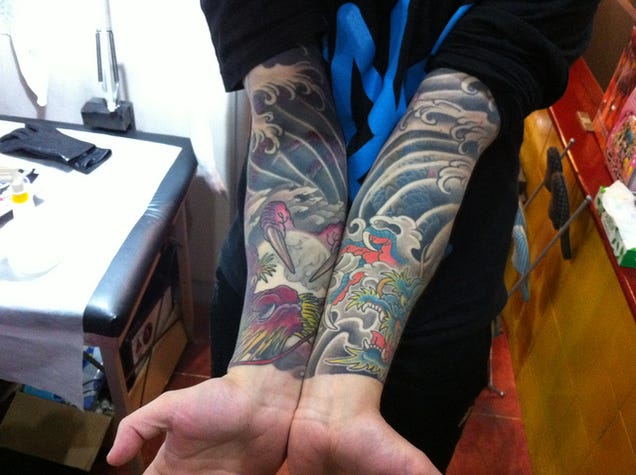
Probably the most wanted Japanese tattoo artist in the world is Horiyoshi III. He is recognized for his stunning, intricate full-body ‘suits’ that can take many years to complete. These are the kind of tattoos that are synonymous with the yakuza — the Japanese mafia, or criminal underworld. This isn’t the glamorous, or honorific lifestyle that is sometimes portrayed, the yakuza are involved in everything from drug sales, prostitution, and gambling, all the way to up the crime in the white-collar world, like loan-sharking and personal or political blackmail. And everyone in Japan knows this. When they see or hear about yakuza and their world, they know it’s dangerous.

Horiyoshi III openly admits that he used to be involved in the criminal lifestyle, although he gave it up long ago to focus on his craft. He hopes that one day his work can contribute to a change in the perception of tattoos for Japanese people, and bring an end to what is sometimes seen as discrimination as people with tattoos.
There's a theory that tattoos were important in the Japan's Jomon Period (10,000 B.C. to 300 B.C.). There isn't any physical proof that the Jomon people tattooed themselves; however, a Chinese historical record written at around 300 A.D. said all Japanese men tattooed their faces and bodies. This history is marked by a love-hate relationship: In the 17th century, for example, criminals were tattooed to blatantly mark them in shame instead of punishment through mutilation. As VanishingTattoo points out, some criminals even had the Japanese for "dog" (inu,犬) inked on their foreheads. During the following century, however, tattoos became fashionable.
However, tattoos were banned in the mid-to-late 19th century as the country opened up to the outside world. The fear was that the custom might seem primitive to foreigners or mocked abroad. The Japanese government saw tattoos as "barbaric" and certainly not part of their program to modernize. It wasn't until after World War II that the legal prohibition against tattooing was lifted. Tattoos are far more of a rarity in daily life in Japan than abroad.
Warning: If you have tattoos and are planning on visiting Japan, you might run into problems at, for example, hot springs and public pools. Either cover your tattoos with bandages or band-aids (if possible!) or rent rooms at hot springs that come with a private bath. For business trips, unless your work is connected to the arts, it might be good to discretely cover your ink (if possible).
-The more you know~
There are prominent, clearly labeled signs at establishments like fitness gyms, public swimming pools, and especially at Japan’s renown hot springs, that state anyone with irezumi, the Japanese word for ‘tattoo,’ are banned from entry. But if you have a much larger tattoo, it is not unheard of to be asked to leave establishments like restaurants or stores. You probably won’t be asked to leave food establishments or shops, but those public places like pools and hot springs will ask you to leave immediately.

Probably the most wanted Japanese tattoo artist in the world is Horiyoshi III. He is recognized for his stunning, intricate full-body ‘suits’ that can take many years to complete. These are the kind of tattoos that are synonymous with the yakuza — the Japanese mafia, or criminal underworld. This isn’t the glamorous, or honorific lifestyle that is sometimes portrayed, the yakuza are involved in everything from drug sales, prostitution, and gambling, all the way to up the crime in the white-collar world, like loan-sharking and personal or political blackmail. And everyone in Japan knows this. When they see or hear about yakuza and their world, they know it’s dangerous.
Horiyoshi III openly admits that he used to be involved in the criminal lifestyle, although he gave it up long ago to focus on his craft. He hopes that one day his work can contribute to a change in the perception of tattoos for Japanese people, and bring an end to what is sometimes seen as discrimination as people with tattoos.
There's a theory that tattoos were important in the Japan's Jomon Period (10,000 B.C. to 300 B.C.). There isn't any physical proof that the Jomon people tattooed themselves; however, a Chinese historical record written at around 300 A.D. said all Japanese men tattooed their faces and bodies. This history is marked by a love-hate relationship: In the 17th century, for example, criminals were tattooed to blatantly mark them in shame instead of punishment through mutilation. As VanishingTattoo points out, some criminals even had the Japanese for "dog" (inu,犬) inked on their foreheads. During the following century, however, tattoos became fashionable.
| full body tattoo |
Warning: If you have tattoos and are planning on visiting Japan, you might run into problems at, for example, hot springs and public pools. Either cover your tattoos with bandages or band-aids (if possible!) or rent rooms at hot springs that come with a private bath. For business trips, unless your work is connected to the arts, it might be good to discretely cover your ink (if possible).
-The more you know~
Interesting Facts!! #36
36. Public Baths and Hot Springs~

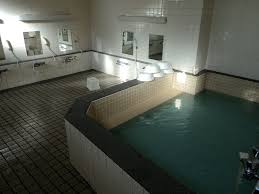
In the past, many homes in Japan were not equipped with a bathtub. To fill this void, the neighborhood public bath (銭湯, sentō, lit. "coin hot water") was a place where the locals could go to wash themselves, soak in a tub and socialize with neighbors.

Nowadays, as most households have their own bath, the number of traditional public baths has decreased, but they can still be found in many of the more old-fashioned city neighborhoods. In addition, a new type of public bath has emerged in recent decades. Much larger than the traditional sento, these bathing complexes features a range of pools, saunas and fitness facilities. Some of the largest resemble small theme parks and offer various dining, entertainment and relaxation services.
Public baths are segregated by gender, and swimsuits are not worn. Some sento, typically in hot spring resort towns, utilize natural hot spring water for their baths. More commonly, however, public baths simply use heated tap water instead. Public baths can be found throughout Japan and typically cost 200 to 2000 yen ($2-$20). Some larger ones - mainly in larger cities - are open 24 hours and could be considered as budget accommodation.
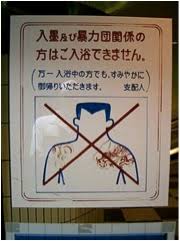
Some public baths have signs refusing entry for people with tattoos. However, one may be allowed in if the tattoos are not too obvious. If one ventures to a public bathing place that is publicly owned, this should not present a problem as they have a duty to let all tax-paying citizens in. The original reason behind the ban was to keep out the yakuza.
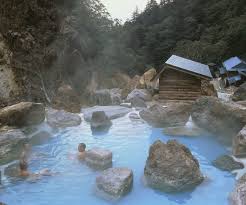 Another type of Japanese public bath is onsen (温泉) i, which uses hot water from a natural hot spring. Natural hot springs (onsen)are numerous and highly popular across Japan. Every region of the country has its share of hot springs and resort towns, which come with them.
There are many types of hot springs, distinguished by the minerals dissolved in the water. Different minerals provide different health benefits, and all hot springs are supposed to have a relaxing effect on your body and mind. At a hot springs, many people do not rinse off the water after getting out of the bath from the skin, to increase exposure to the minerals. In a regular sentō,people usually rinse off at the faucets.
Hot spring baths come in many varieties, indoors and outdoors, gender separated and mixed, developed and undeveloped. Many hot spring baths belong to a ryokan, while others are public bath houses. An overnight stay at a hot spring ryokan is a highly recommended experience to any visitor of Japan.

Ryokan are Japanese style inns found throughout the country, especially in hot spring resorts. More than just a place to sleep, ryokan are an opportunity to experience the traditional Japanese lifestyle and hospitality, incorporating elements such as tatami floors, futon beds, Japanese style baths and local cuisine, making them popular. There are many different kinds of ryokan, varying greatly in terms of size, cost and style. Some ryokan are small, family run establishments with just a few rooms, while others are large, hotel-like facilities with hundreds of rooms. Ryokan also range from no-frills, budget varieties to costly establishments catering to the very wealthy.
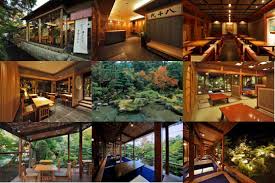

While extremes exist, the average cost of a ryokan stay is between 15,000 and 25,000 yen ($150.00 - $250.00) per person, per night. While this may be too expensive to stay at everyday, it is well worth indulging on one special night during your travels. Also keep in mind that ryokan stays usually include an elaborate dinner in the evening, followed by breakfast the next morning. Meals are typically kaiseki ryori (Japanese cuisine) that feature local and seasonal specialties.
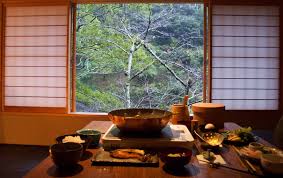
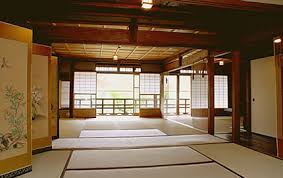
So if you get to stay at a Ryokan, do so! Because of their emphasis on traditional style and atmosphere, ryokan may appear rigid and intimidating but don't let that stop you from experiencing something so special and relaxing.

If you visit Japan explore and have a good experience by going to a public bath, hot springs or a ryokan at least one time.
-The more you know~
Nowadays, as most households have their own bath, the number of traditional public baths has decreased, but they can still be found in many of the more old-fashioned city neighborhoods. In addition, a new type of public bath has emerged in recent decades. Much larger than the traditional sento, these bathing complexes features a range of pools, saunas and fitness facilities. Some of the largest resemble small theme parks and offer various dining, entertainment and relaxation services.
Public baths are segregated by gender, and swimsuits are not worn. Some sento, typically in hot spring resort towns, utilize natural hot spring water for their baths. More commonly, however, public baths simply use heated tap water instead. Public baths can be found throughout Japan and typically cost 200 to 2000 yen ($2-$20). Some larger ones - mainly in larger cities - are open 24 hours and could be considered as budget accommodation.
Taking a bath at a public sentō requires at a bare minimum a small towel and some soap/shampoo. Attendants usually sell these items for 100-200 yen($1-$2). Many people bring two towels; a handtowel for drying and a handtowel or washcloth for washing.
Some public baths have signs refusing entry for people with tattoos. However, one may be allowed in if the tattoos are not too obvious. If one ventures to a public bathing place that is publicly owned, this should not present a problem as they have a duty to let all tax-paying citizens in. The original reason behind the ban was to keep out the yakuza.
There are many types of hot springs, distinguished by the minerals dissolved in the water. Different minerals provide different health benefits, and all hot springs are supposed to have a relaxing effect on your body and mind. At a hot springs, many people do not rinse off the water after getting out of the bath from the skin, to increase exposure to the minerals. In a regular sentō,people usually rinse off at the faucets.
Hot spring baths come in many varieties, indoors and outdoors, gender separated and mixed, developed and undeveloped. Many hot spring baths belong to a ryokan, while others are public bath houses. An overnight stay at a hot spring ryokan is a highly recommended experience to any visitor of Japan.
While extremes exist, the average cost of a ryokan stay is between 15,000 and 25,000 yen ($150.00 - $250.00) per person, per night. While this may be too expensive to stay at everyday, it is well worth indulging on one special night during your travels. Also keep in mind that ryokan stays usually include an elaborate dinner in the evening, followed by breakfast the next morning. Meals are typically kaiseki ryori (Japanese cuisine) that feature local and seasonal specialties.
So if you get to stay at a Ryokan, do so! Because of their emphasis on traditional style and atmosphere, ryokan may appear rigid and intimidating but don't let that stop you from experiencing something so special and relaxing.
If you visit Japan explore and have a good experience by going to a public bath, hot springs or a ryokan at least one time.
-The more you know~
Subscribe to:
Posts (Atom)