Sunday, April 12, 2015

Interesting Facts!! #54

54. Sushi Train


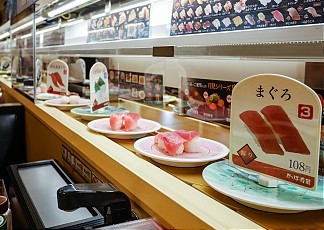
Kaiten-zushi is a sushi restaurant where the plates with the sushi are placed on a rotating conveyor belt. sushi train also known as a Conveyor belt sushi or sushi-go-round is a form of fast-food sushi common in Japan.Customers may place special orders, but most simply pick their selections from a steady stream of fresh sushi moving along the conveyor belt. The final bill is based on the number and type of plates of the consumed sushi. 

The menu usually features seasonal ingredients in addition to standard items like salmonmaguro (tuna), shrimp and kappamaki (cucumber roll). Many also serve cooked foods, such as miso soup and chawanmushi (steamed egg custard), fried foods and desserts. Sushi pieces usually come with wasabi inside, although it can also be ordered without.


These restaurants typically use plates of different colors and patterns to indicate their costs. Prices range from about 100 yen to 500 yen or more depending on the item, although some restaurants also maintain a flat rate for all plates (usually 100 yen). Plates typically come with one or two sushi pieces each. A description of the plates with their accompanying prices can be found on the menu or on signs placed around the restaurant. Seating is usually provided by counter seats along the conveyor belt, but many establishments also offer tables.


At each seat, there is a bottle of soy sauce, a container of pickled ginger, a stack of small dishes for the soy sauce, a box of chopsticks, a small container of green tea powder (or teabags), tea cups and a built-in hot water dispenser. Tea is usually self-serve. To make it, place some green tea powder into the cup and add hot water from the dispenser. Once seated, you can start taking plates of food off the conveyor belt or order specific dishes directly from the sushi chef or server. Some establishments also offer touchpads to place orders electronically.

At the end of the meal, the server will calculate the bill based on the number of empty plates. You will then be handed your bill to be paid at the register near the exit.


Etiquette

Do not touch plates on the conveyor belt unless you intend to take them.
Do not put plates back onto the conveyor belt.

-The more you know~

Friday, March 13, 2015

Interesting Facts!! #53

53. Sakura Trees 

Image result for cherry blossom

cherry blossom is the flower of any of several trees of genus Prunus, particularly the Japanese Cherry, Prunus serrulata, which is called sakura. People obsess over them, their rare public appearances send fans into a frenzy, and the most devoted enthusiasts will even follow their flowering tour as it spreads from Japan’s warmer southern prefectures to the chillier north.
 There are three sakura trees that are considered to be the absolute peak of the pink-flowers.

Image result for Miharu Takizakura Miharumachi

First up is the Miharu Takizakura, found in the Miharumachi section of Tamuragun County in Fukushima PrefectureSakura have long been revered in Japan, with the practice of holding cherry blossom viewing parties, or hanami, said to date back to at least the 8th century. As such, many of the most beautiful specimens have been lovingly cared for over hundreds of years. The Miharu Takizakura, which is over 1,000 years old.The tree is 12 meters (39 feet, 4 inches) tall, and at its widest point the canopy measures 25 meters across. Takizakura literally means “waterfall sakura,” and is a reference to the weeping tree’s curved branches, and also serves as a metaphor for the way the flowers’ petals cascade down from them after the sakura reach full bloom.


Image result for Usuzumi Sakura in Moyosu

The Usuzumi Sakura in Moyosu, Gifu Prefecture, which is over 1,500 years old has also reached the millennium markAccording to historical records, the 16-meter-tall tree was planted by Japan’s Emperor Keitai, who reigned over the country during the early sixth century. Like the Mihara Takizakura, the Usuzumi Sakura has a meaningful name. Translating as“pale black ink sakura,” it refers to the colors of the trees’ flowers. Prior to the flowers’ opening, their buds are a soft pink, and in full bloom, they’re almost entirely white. When they fall from the tree, however, they turn a pale ashen color, hence the name.


TS 4
Finally, the oldest of Japan’s three great sakura trees is Yamanashi Prefecture’s Jindaizakura, in the Takekawacho district of Hokuto City.Meaning “divine generations sakura,” the tree is appropriately within the grounds of Jissoji Temple. Its exact age is unknown, although estimates place it somewhere around1,800 to 2,000 years.

Sakura are notoriously fickle regarding when they’ll bloom, but in most years the Usuzumi Sakura and Jindaizakura are at their most beautiful in early April. Being the farthest north of the three, the Miharu Takizakura blooms in mid to late April, meaning that as long as you don’t mind a bit of travelling about, with good timing you can hit all three of Japan’s best sakura trees before their petals hit the ground.

-The more you know~