60. Sumo Wrestling
Sumo is a Japanese style of wrestling and Japan's national sport. In line with tradition, only men practice the sport professionally in Japan.
From around the Heian period (794-1192), the imperial family often watched sumo as a form of entertainment. Sumo evolved over many centuries, with the first professional sumo wrestlers appearing in the Edo period (1603-1868). Because of this long history, sumo is considered Japan's national sport.
The rules of sumo wrestling are simple: the wrestler who first exits the ring or touches the ground with any part of his body besides the soles of his feet loses. Matches take place on an elevated ring (dohyo), which is made of clay and covered in a layer of sand. Usually a contest lasts only a few seconds, but in rare cases it can take a minute or more. There are no weight restrictions or classes in sumo, meaning that wrestlers can easily find themselves matched off against someone many times their size. As a result, weight gain is an essential part of sumo training.
 Due to traditional Japanese diet, it would be hard to gain weight in a country where everyone is very slim, so sumo wrestlers diet consist of chankonabe. Chankonabe is a type of Japanese stew made to pack on the pounds, on average it has 10,000 calories. This dish has various of meats and vegetables in it, this is much better than eating junk foot after a long day of training or a tournament.
There are many religious traditions in sumo: wrestlers sip sacred water and throw purifying salt into the ring before a match; the referee dresses like a Shinto priest, a Shinto shrine hangs over the ring. When wrestlers enter the ring they clap their hands to summon the gods. In addition to wrestlers’ colorful mawashi (belly bands) and distinctive hair styles called oicho, both of which evoke images of ancient times.
- The more you know~
59. Women Only Train Cars
There are subway and train cars offered in Japan that are only intended to be used by women, labeled Women-only Passenger Car or "The Flower Train". These types of trains have been around for around 50 years in Japan but recently boomed. Other countries such as India, Egypt, Iran, Brazil, etc have these cars, while other countries have demanded their introduction.

 Particularly, in Japan women only cars were introduced to fight against gropers (Chikan). The women only car policies vary from company to company: some women only cars are only effective during rush hour, others throughout the day or only are available for express subways and trains. Generally, these cars are in effect weekdays, except holidays. Posted throughout the platforms and train doors are signs that indicate which cars are for women only,and the dates and times they are in use. Although only intended for women, young male elementary school student, people with disabilities and their assistants are allowed to board the women-only cars by most train operators in Japan.
 In crowded commuter trains, groping has been a major problem in Japan according to a survey that was conducted. The survey revealed that two-third of female passengers in their 20s and 30s had been reportedly groped on trains, and the majority had be frequently victimized. The authorities are unable to stop these criminals due to the crowded trains and the inability to pinpoint the perpetrators, courts have been lenient, and the victims are too ashamed to come forward about the incident. Railway companies and the police have worked together to bring awareness to this shameful act by putting up posters (stating molesting is a crime and to speak up) but there has been no reverse to this trend. Over a time of 8 years the Tokyo police reported, in 2004, a threefold increase of reported groping on public transportation.
 Many train companies had to introduce late-night and evening rush hour women only cars due to complaints of drunken men being gropers, and mixed train cars being too crowded and the stops too far apart allowing the gropers more of a chance to violate women.The ineffectiveness of campaigns to raise awareness to and prevent groping lead to many more train companies to follow suit and provide women only cars throughout the day.
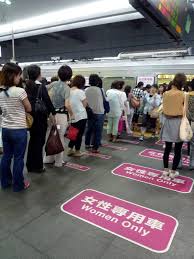 Both men and women in Japan have shown positive reactions to the women only cars. Women have stated the safety they feel away from potential groping, and not having to tolerate various smells on a crowded mixed-gender train car. Men expressed not having to be worried of false accusations of being a groper. Many still believe that mixed trains are far too crowded and put women at more of a risk than ever. Foreign or visually-impaired men had been seen unknowingly boarding and riding on women only trains, passengers would notify them and the men would face serious embarrassment.
When visiting Japan when commuting be aware of which cars are mixed and women only. If you a male you don't want to face the embarrassing situation when you figure out you are in a car only for women. If you are a female and feel uncomfortable riding in an overly crowded mixed train, feel free to enter that women only car they were made for your safety!
-The more you know~

